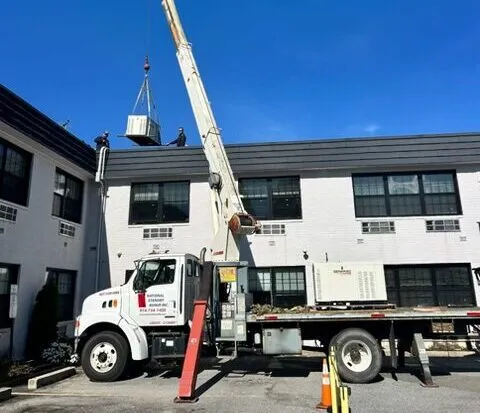
A Complete Guide for Business Owners Looking for Commercial Standby Generator Installation in New York
Serving New York City | Westchester | Long Island | Hudson Valley
When a facilities director in Manhattan or a property manager in White Plains starts asking around about commercial standby generator installation, they quickly discover the market is full of noise: electrical contractors who dabble in generators, equipment dealers who outsource the install, and national chains with no knowledge of New York’s regulatory environment. The result is projects that run over budget, miss code requirements, or produce a generator that fails the first time it is actually needed.
This guide covers what New York City business owners, commercial property managers, and facilities teams need to know to make a sound installation decision — from sizing methodology and fuel selection to NYC building and fire code requirements, transfer switch configurations, and what genuinely separates a capable provider from one that has spent decades doing this work in the New York metro area.
What’s at Stake: Why Installation Quality Matters More Than Equipment Brand
A Kohler or Cummins generator is only as reliable as the installation behind it. The most common causes of commercial generator failure during an actual outage are not equipment defects — they are installation errors, improper load sizing, inadequate transfer switch configuration, and missed maintenance milestones that a competent installer would have caught.
New York commercial facilities face a specific convergence of risk factors that make generator reliability non-negotiable:
- Dense utility infrastructure prone to storm-related outages — nor’easters, hurricane remnants, ice events, and heat-wave load shedding
- Aging grid segments in legacy urban centers across New York City and its inner suburbs
- A layered regulatory environment requiring documented standby power for healthcare, data, and life-safety systems
- Commercial real estate values where operational downtime translates directly and immediately to financial loss
The question is never just “what generator should I buy?” It is: who has the expertise to size it correctly, install it to code, commission it properly, and keep it running for the next 20 years in a New York building?
Sizing a Commercial Standby Generator for Your Building
Getting the sizing right is the single most consequential technical decision in a commercial generator project. Undersizing leads to overloaded systems, nuisance shutdowns, and premature equipment failure. Oversizing wastes capital and creates operational problems — diesel generators in particular suffer from wet stacking (incomplete fuel combustion and carbon buildup) when run at chronically low loads.
The Load Analysis: What It Actually Covers
A professional load analysis catalogs every electrical load in the building that the generator must support, then calculates running watts and — critically — startup surge requirements. Equipment with electric motors draws three to six times more current at startup than at steady state. HVAC compressors, elevators, and refrigeration systems are the primary surge drivers in most commercial buildings.
Key load categories for New York commercial buildings include:
- HVAC systems — the single largest load in most buildings; chiller startup surge is typically the primary sizing constraint
- Elevators — required under NYC Building Code for buildings above certain heights; each car carries significant inrush demand
- Data and communications equipment — servers, networking infrastructure, phone systems, and security platforms
- Lighting — emergency egress lighting at minimum; full building lighting for continuously occupied facilities
- Refrigeration — restaurants, food service operations, medical practices, and laboratories
- Fire alarm and suppression systems — life-safety loads with specific requirements under NFPA 72 and NYC Fire Code
- Security and access control — electronic locks, cameras, card readers, and intercom systems
Demand Factor, Load Diversity, and Harmonics
Experienced engineers apply a demand factor — the realistic percentage of total connected load that will operate simultaneously — and a load diversity calculation that accounts for staggered motor starting. For buildings with significant variable frequency drives or large UPS systems, harmonic distortion analysis is also required; these loads can cause generators to behave erratically if not accounted for in the specification.
N+1 Redundancy for Mission-Critical Facilities
Hospitals, data centers, financial institutions, and emergency operations centers frequently specify N+1 or 2N redundancy configurations — where one or more complete backup generator sets are maintained beyond total load requirements. Parallel generator installations require more sophisticated controls and switchgear but are the correct standard for any facility where downtime is genuinely not an option.
NYC Building Code and Fire Code Compliance
Commercial generator installations in New York City operate under a layered regulatory framework involving the Department of Buildings, the Fire Department of New York, the applicable utility, and — for larger systems — the New York State Department of Environmental Conservation. Getting any layer wrong can mean stop-work orders, Certificate of Occupancy holds, insurance voidance, and expensive remediation.
NYC Department of Buildings (DOB)
All commercial generator installations in New York City require permits filed with the DOB. Depending on project scope, filings will involve some combination of:
- Electrical work permit — under the NYC Electrical Code, which incorporates the National Electrical Code with local amendments
- Mechanical permit — for generator equipment, exhaust routing, and fuel system installation
- Plumbing permit — where the installation involves fuel gas piping
Generators above certain capacity thresholds require sign-off from a New York State licensed Professional Engineer or Registered Architect. All field work must be performed by appropriately licensed master electricians and plumbers.
FDNY and the NYC Fire Code
The New York City Fire Code imposes specific requirements on commercial generator fuel storage and handling that have no equivalent in most other jurisdictions:
- Diesel fuel storage — tanks above specified capacities require a Certificate of Fitness holder on premises and FDNY permits; sub-base and day tanks must meet containment, venting, and fill-point requirements
- Natural gas systems — installations connecting to utility mains require coordination with Con Edison or National Grid and compliance with the NYC Fuel Gas Code
- Fire-rated generator rooms — generators installed within or adjacent to buildings require rated enclosures with engineered ventilation, fire suppression provisions, and emergency shutoffs accessible to FDNY
- Emergency access — generator rooms must meet egress and clearance standards to permit emergency responder access under load
Local Law 97 and Carbon Compliance
New York City’s Local Law 97 imposes carbon emissions caps on large commercial buildings with escalating penalties through 2030 and beyond. Generator selection — particularly fuel type, anticipated annual operating hours, and whether the system will be used for demand response or peak shaving — should be evaluated against LL97 obligations. Facilities teams with significant backup power requirements should engage a provider who understands both the power reliability and carbon reporting dimensions of the installation.
Westchester, Long Island, and Hudson Valley Jurisdictions
Outside the five boroughs, commercial installations are governed by local municipal building departments, the National Electrical Code, and New York State environmental regulations. Diesel generator emissions require review under NYS DEC air permitting rules for larger units or any facility planning to operate generators beyond de minimis testing thresholds. Every municipality in the metro area has its own permit workflow, subcode officials, and inspection process — regional experience with these relationships materially affects project timelines and approval outcomes.
Diesel vs. Natural Gas vs. Propane: Choosing the Right Fuel
Fuel type is one of the highest-leverage decisions in a commercial generator project. Each option carries distinct tradeoffs across upfront cost, ongoing operating cost, fuel availability during extended outages, emissions profile, and regulatory treatment in New York.
| Factor | Natural Gas | Diesel |
|---|---|---|
| Fuel Storage | No on-site storage (utility supply) | On-site tank required; secondary containment per NYC regs |
| Runtime | Unlimited while utility gas flows | Limited to tank capacity (typically 24–96 hours) |
| Cold-Weather Start | Excellent | Requires block heaters; gelling risk below 10°F |
| NYC/NY Environmental | Lower emissions; FDNY storage requirements simplified | NYS DEC air permits may apply; EPA Tier 4 Final compliance required |
| Best For | Urban buildings where on-site storage is constrained; emissions-priority facilities | Mission-critical facilities requiring grid-independent operation |
| Fuel Cost | Stable utility rate | Market-variable; storage, delivery, and polishing costs apply |
Propane
Propane is most common in suburban commercial applications across Westchester, Long Island, and the Hudson Valley. It stores on-site like diesel — providing utility-independent operation — without diesel’s fuel degradation concerns; propane stores indefinitely without treatment. Emissions are cleaner than diesel. The tradeoffs include lower energy density (requiring larger tank volume for equivalent runtime), higher per-BTU cost than utility natural gas, and limited availability above 500 kW. Propane is the right choice for suburban commercial facilities and medical offices in areas without reliable natural gas distribution infrastructure.
NSR’s certified engineers can perform a fuel feasibility study for your New York location to determine the optimal fuel solution before any equipment is specified.
Transfer Switches: Open Transition, Closed Transition, and Bypass Isolation
The transfer switch is the control interface between utility power, the generator, and the building’s electrical loads. Specifying the wrong configuration is a common and expensive error that often isn’t discovered until a maintenance window or an actual outage creates the test.
Automatic Transfer Switch: The Baseline Requirement
Every standby generator installation requires an Automatic Transfer Switch. The ATS monitors utility power continuously, detects a supply loss, signals the generator to start, and transfers building loads to generator power once the unit is running and stable within specification. On utility restoration, the ATS transfers loads back and initiates generator cool-down.
Open Transition (Break-Before-Make)
In an open transition transfer, the building load is briefly disconnected from both utility and generator during the transfer — typically 100–200 milliseconds. This is the standard configuration for the majority of commercial standby applications. Most equipment handles the transition without issue; computers and sensitive electronics on UPS systems ride through seamlessly. Open transition is not appropriate for facilities where any interruption to loads is operationally or clinically unacceptable.
Closed Transition (Make-Before-Break)
A closed transition switch briefly parallels the generator with utility power during the transfer, producing a seamless, bumpless load handoff. The generator is synchronized to the utility before the utility source is opened, typically within a 100-millisecond parallel window. Closed transition is appropriate for facilities with loads that cannot tolerate even momentary interruption — certain medical applications, financial trading environments, and operations with large motor loads. It requires synchronization-capable generator controls and must comply with Con Edison and National Grid utility interconnection requirements.
Bypass Isolation
A bypass isolation configuration adds a maintenance bypass path to the transfer switch, allowing the ATS itself to be isolated, tested, and serviced while the building remains continuously energized. This is required for any facility where taking the transfer switch out of service for maintenance is operationally unacceptable, and is mandatory for NFPA 110 Level 1 systems — hospitals, data centers, emergency operations centers, and facilities classified as essential to public safety. Bypass isolation should be specified from the outset; retrofitting it to an existing installation is significantly more costly than including it in the original design.
Switchgear for Larger and Parallel Installations
For commercial facilities above approximately 400–600 kW, or any installation involving parallel or redundant generators, transfer switching is handled by low-voltage or medium-voltage switchgear rather than a standalone ATS. Switchgear provides the source management flexibility, granular load control, and parallel generator coordination that complex commercial and institutional facilities require.
NSR’s New York Coverage: Where We Work
National Standby Repair provides commercial generator installation, service, and 24/7 emergency dispatch throughout the New York metro area.
New York City
From high-rise office buildings in Midtown Manhattan to mixed-use developments in Brooklyn and Queens, NSR navigates the full DOB permitting process, FDNY fuel and enclosure requirements, and Con Edison utility coordination that NYC commercial installations demand. Our teams work in occupied buildings, constrained mechanical rooms, and complex tenant environments without disrupting building operations.
Westchester County
Westchester’s dense mix of corporate campuses, healthcare systems, and Class A office parks requires generators that meet NYC-adjacent code standards while navigating Con Edison and O&R utility interconnection requirements. NSR has decades of permit history with building departments across White Plains, Yonkers, Tarrytown, Rye, and the county’s full geography.
Long Island (Nassau and Suffolk Counties)
NYC’s close-in suburbs present tight installation footprints, noise ordinance requirements, and PSEG Long Island utility coordination. NSR’s experience across Nassau and Suffolk means faster permitting, familiar inspectors, and installations built to the specific requirements of each Long Island municipality.
Hudson Valley (Dutchess, Orange, Rockland, Putnam, Ulster Counties)
NSR’s Hudson Valley coverage extends north through the full mid-Hudson corridor, serving large commercial, industrial, and institutional clients — including multi-unit parallel configurations for mission-critical campuses.
NSR also serves Rockland County, Orange County, Nassau County, Suffolk County, and commercial clients throughout New York State.
Why New York Businesses Choose National Standby Repair
National Standby Repair has been New York’s dedicated commercial standby power specialist since 1981. Over four decades of generator installations, service calls, emergency dispatches, and long-term maintenance relationships — built exclusively in this market.
| Capability | What NSR Delivers |
|---|---|
| Factory Certifications | Kohler, Generac, Cummins, Briggs & Stratton, and Winco — equipment recommendations driven by your load profile, not by what we sell |
| EGSA-Certified Technicians | Individual technician credentialing at the generator industry’s highest standard — not a general electrician’s license; covers the complete power generation system from crankshaft to transfer switch |
| 40+ Years in the NYC Market | Serving New York City, Westchester, Long Island, and the Hudson Valley since 1981 — permit relationships, utility contacts, and institutional knowledge that accelerate approvals and prevent costly errors |
| 24/7 Staffed Emergency Dispatch | 365 days a year — no answering services, no surcharges for nights or weekends; on-call technicians with fully stocked service vehicles across the metro area |
| Full Permit Management | NSR handles permit procurement and inspection coordination across all NYC DOB, FDNY, and New York State jurisdictions |
| Engineered Load Sizing | Formal load analysis covering running loads, inrush current, harmonics, and planned growth — not rule-of-thumb estimates |
| Annual Service Contracts | Scheduled preventive maintenance, NFPA 110 compliance documentation, load bank testing, and priority emergency dispatch status |
| Trust & Credentials | Veteran-Owned Business |
Frequently Asked Questions
How long does a commercial generator installation take in New York?
For most commercial projects in the NYC metro area, plan for 3–6 months from initial assessment to commissioned equipment. NYC DOB permitting timelines, equipment manufacturing lead times of 8–20 weeks for larger units, and site preparation all factor into the schedule. Starting this process before there is an urgent need is essential — do not begin when a storm forecast is already on the radar.
Do I need a permit for a commercial generator installation in New York?
Yes. Commercial installations require permits from the NYC DOB or applicable local building department and may require additional filings with the FDNY, Con Edison or PSEG Long Island, and the NYS DEC. All work must be performed by licensed contractors. Unpermitted installations face stop-work orders, Certificate of Occupancy holds, and insurance complications.
What size generator does my commercial building need?
Generator sizing requires a professional load analysis of your specific facility. There is no reliable rule of thumb. Contact National Standby Repair for a site assessment.
What is the difference between a standby generator and a portable generator?
A commercial standby generator is a permanently installed, automatic system connected to the building through a transfer switch. It starts within seconds of a utility failure without any manual intervention and can support an entire building or selected critical loads. A portable generator requires manual setup, runs on small fuel quantities, and is entirely unsuitable for commercial applications.
How often does a commercial standby generator require testing and maintenance?
NFPA 110 requires monthly exercise testing at minimum 30% rated load and annual full-load testing for legally required standby and emergency systems. Preventive maintenance intervals vary by fuel type and manufacturer specification. National Standby Repair’s Annual Service Contracts cover scheduled testing, documented maintenance, and NFPA 110 compliance recordkeeping.
Whether your facility is in Manhattan, White Plains, Yonkers, Long Island City, Garden City, or anywhere across the New York metro area — National Standby Repair has the certifications, the regional expertise, and the 24/7 capability to support your standby power needs.
Contact NSR today to schedule a commercial power assessment for your New York City, Westchester, Long Island, or Hudson Valley facility.
Factory-Certified | EGSA-Certified Technicians | Serving NYC Metro Since 1981 | 24/7 Emergency Dispatch